
Amazon The World’s Shopping Giant Is Becoming an AI Infrastructure Company
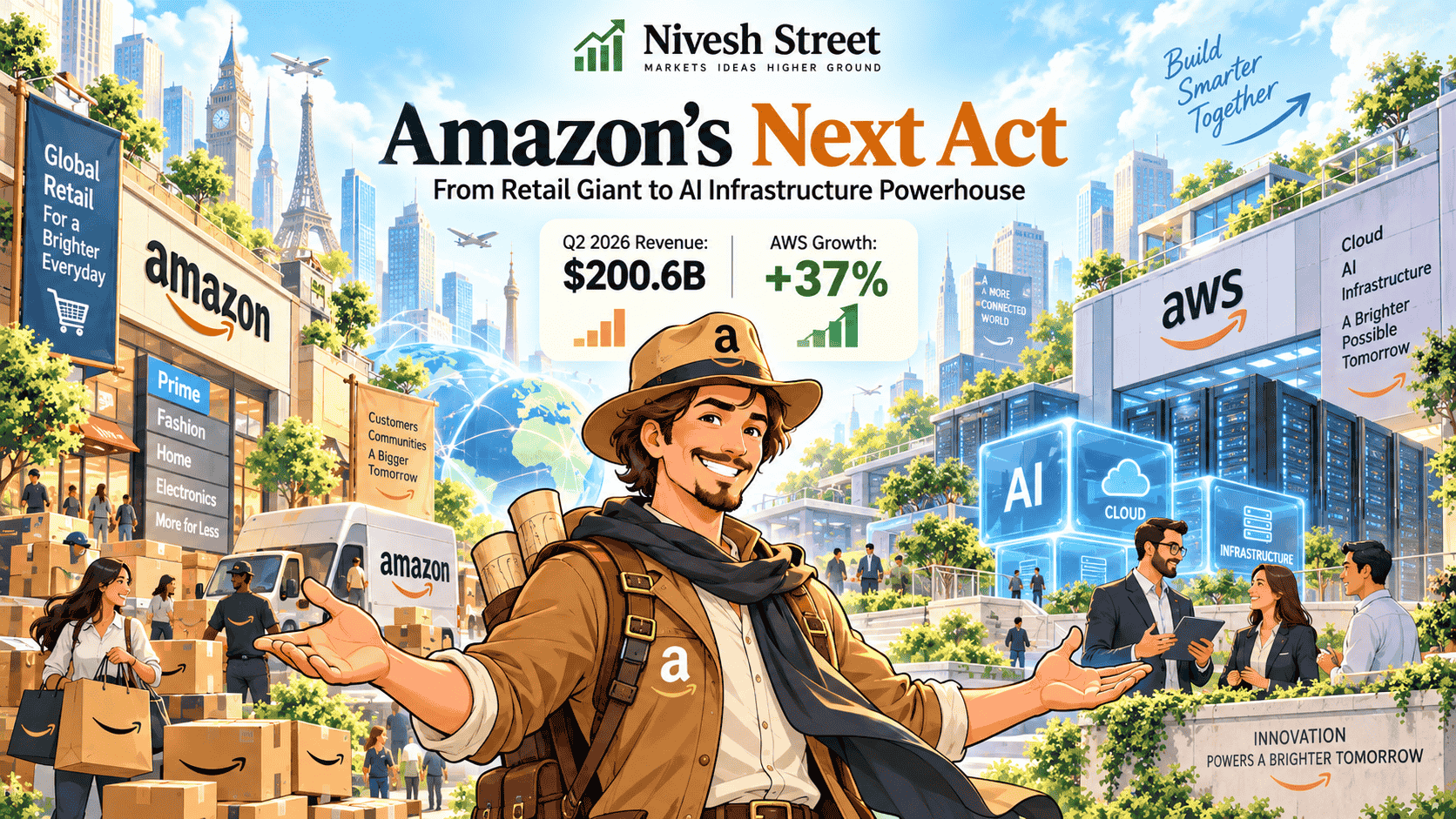
When investors hear Amazon, they still think e-commerce. In 2026, that description is becoming increasingly incomplete. Amazon is evolving into a company sitting simultaneously across global retail, cloud computing, artificial intelligence, custom semiconductors, advertising and financial services — and the numbers suggest AWS may increasingly determine how the market values the entire group.
For a Nivesh Street Company Spotlight, Amazon is also one of the strongest companies to cover from a global search perspective. Glimpse’s September 2026 ranking, built from more than 25 billion keywords, estimates that “amazon” generated about 270.6 million Google searches globally during the previous 30 days, making it the fifth-most searched term overall. Apple, by comparison, ranked 14th at roughly 164 million searches. Search volume is not the same thing as investment interest — much of Amazon’s traffic is naturally shopping-related — but few listed companies combine this level of consumer attention with such a large role in the global technology and AI investment cycle.
Amazon Is No Longer Just a Retail Story
Amazon's second quarter of 2026 illustrated how quickly the company is changing. Revenue increased 20% year-on-year to $200.6 billion, while operating income jumped 43% to $27.5 billion. North American sales reached $116.2 billion and international sales reached $42.2 billion, but the most important number was Amazon Web Services. AWS revenue increased 37% to $42.2 billion, its fastest growth in 18 quarters, taking the cloud business to an annualised revenue run rate of roughly $169 billion. What began as infrastructure Amazon originally built for itself has become one of the world's most important computing platforms — and increasingly one of the foundations on which the AI industry is being constructed.
That distinction matters for valuation. Retail creates enormous revenue but historically operates on thinner margins, while cloud infrastructure produces significantly greater profitability. As AWS becomes a larger part of Amazon's earnings engine, investors are effectively valuing two very different businesses under one ticker: one of the world's largest retailers and one of the world's most strategically important technology infrastructure providers. The acceleration in AWS growth is therefore arguably more important to Amazon's long-term market value than whether its e-commerce business grows a few percentage points faster or slower in any particular quarter.
The $220 Billion AI Bet
Amazon is now spending at a scale that would have sounded extraordinary even a few years ago. The company lifted its expected 2026 capital expenditure to around $220 billion, driven heavily by data centres, servers and AI infrastructure. AWS CEO Andy Jassy has even argued that the cloud business could eventually become a $1 trillion annual-revenue business, although reaching anything close to that level would require years of exceptional growth. The magnitude of today's investment therefore tells investors how large Amazon believes the future demand for AI computing could become.
This investment boom also represents one of Amazon's largest risks. AI infrastructure is enormously capital intensive, and the world's largest technology companies are spending unprecedented amounts before anyone can know precisely what long-term returns these investments will generate. The Bank for International Settlements estimates that the five largest global technology companies will invest more than $1 trillion in AI across 2025 and 2026, while total global AI investment could potentially approach $4 trillion by 2030. The opportunity is enormous, but so is the possibility that parts of the industry eventually build more computing capacity than the economics can justify.
Amazon Is Building Its Own AI Supply Chain
One of the most interesting developments came this week. Qualcomm announced a long-term partnership under which Amazon could purchase as much as $60 billion of AI data-centre chips and related technology. The companies will collaborate on multiple generations of customised silicon focused particularly on AI inference — the stage where trained AI models actually process user requests — while also developing high-speed optical connectivity for data centres. Qualcomm granted Amazon warrants potentially worth about $4 billion as part of the agreement.
The strategic significance goes beyond Qualcomm. Nvidia remains the dominant supplier of advanced AI processors, but hyperscalers increasingly want alternatives. Amazon already develops its own Trainium and Inferentia chips, and bringing additional semiconductor partners into the ecosystem can reduce dependence on a single supplier while potentially lowering the cost of operating massive AI workloads. Amazon's custom-chip business had already reached an annualised revenue run rate above $25 billion by the end of the June quarter, according to Reuters. If AI inference eventually becomes much larger than training — because billions of people and businesses repeatedly use AI models after they have been built — controlling the cost of inference could become one of AWS's biggest competitive advantages.
Then There Is Anthropic
Amazon's relationship with Anthropic may become another critical part of the investment story. Anthropic, one of the world's largest AI model developers, has committed enormous spending to Amazon's AWS infrastructure, with Reuters reporting planned commitments of around $100 billion. Anthropic is now preparing for what could become one of the largest IPOs in history, potentially raising as much as $100 billion at a valuation approaching $2 trillion, while Nvidia is reportedly discussing an investment of up to $10 billion in the offering.
This illustrates how interconnected the AI economy has become. Amazon invests in AI companies; those companies spend enormous amounts on AWS infrastructure; AWS purchases chips and data-centre equipment from semiconductor manufacturers; semiconductor companies depend on those hyperscaler purchases to fund the next generation of processors. If AI demand continues expanding, this ecosystem can generate extraordinary growth. If the expected economic returns from AI disappoint, however, the same interconnectedness could amplify the slowdown. For Amazon investors, Anthropic is therefore both a major potential growth engine and something worth monitoring as AI investment becomes increasingly circular.
Amazon Is Expanding Far Beyond Technology
Amazon's ambition is also becoming increasingly visible in markets such as India. Amazon Pay is expanding further into financial services, including health and travel insurance, while positioning itself across payments, credit, insurance, savings and potentially investment products. The company already distributes vehicle and health insurance in India, has invested in insurer Acko and previously acquired lending platform Axio. India's general insurance market is projected to grow from around $43.4 billion in 2026 to more than $62 billion by 2030, giving Amazon another large market where its enormous customer base could become a distribution advantage.
This is a useful reminder of why Amazon remains difficult to classify. It is simultaneously competing with Walmart in retail, Microsoft and Google in cloud computing, Nvidia and other chipmakers through custom silicon, Meta and Google in advertising, fintech companies in payments and lending, and increasingly financial institutions in selected markets. Very few companies operate across so many industries while sharing the same underlying customer, logistics and technology infrastructure.
The Biggest Risk Is No Longer Retail Competition
The market once worried that another e-commerce company might take share from Amazon. That is no longer the most important risk. The bigger question is whether Amazon can earn sufficient returns on the enormous capital being deployed into AI. Spending $220 billion in a single year creates very different financial expectations from operating a relatively asset-light internet marketplace. Data centres require land, electricity, cooling, networking, semiconductors and increasingly debt financing, while technology cycles can change quickly. A server that looks strategically critical today can become less valuable if new chip architectures dramatically improve performance per dollar.
Competition is also intensifying. Microsoft Azure and Google Cloud are spending aggressively, Nvidia is attempting to move further up the AI infrastructure stack, and AI developers increasingly design their own hardware. Even Qualcomm's Amazon partnership demonstrates the speed at which new competitors are entering the data-centre processor market. Amazon therefore has enormous advantages — scale, customer relationships, AWS, proprietary chips and capital — but it is competing in perhaps the most expensive technology race the world has ever seen.
Nivesh Street View
The market may still classify Amazon as a consumer internet company, but its future increasingly looks like an infrastructure story. Retail provides Amazon with scale, customers and cash flow; advertising monetises its enormous commercial ecosystem; but AWS and AI infrastructure increasingly determine where the next phase of growth could come from. The 37% growth in AWS, Amazon's $220 billion investment programme, the Qualcomm chip agreement and the deep relationship with Anthropic all point in the same direction: Amazon wants to own as much of the AI computing stack as possible.
There is an important difference between Amazon and many companies attempting to benefit from the AI boom. Amazon already owns a massive profitable cloud business with enterprise customers around the world. It does not need to invent an entirely new market to monetise artificial intelligence; it needs existing AWS customers to consume more compute, storage, networking, database services and AI inference. That makes the investment thesis easier to understand — although not necessarily cheap or risk-free.
Nivesh Street Bottom Line
Amazon may be one of the world's most searched companies because people want to buy products, but investors increasingly need to study it because companies want to buy computing power.
The transformation from online retailer → cloud giant → AI infrastructure platform could define Amazon's next decade. If the global AI spending cycle continues, AWS could become considerably larger and more strategically important than it is today. If AI infrastructure spending eventually proves excessive, Amazon's enormous capital commitments could instead become the biggest challenge facing the company.
For now, however, the numbers are moving in Amazon's favour: revenue above $200 billion in a quarter, AWS growing 37%, custom AI chips becoming a multibillion-dollar business and one of the world's largest AI labs committing enormous spending to its infrastructure.
Amazon built one of the world's largest marketplaces for products. The next question is whether it can build the world's largest marketplace for computing intelligence.
This article is for informational and educational purposes only and does not constitute investment advice.