
Copper: The Metal Powering the Next Industrial Supercycle
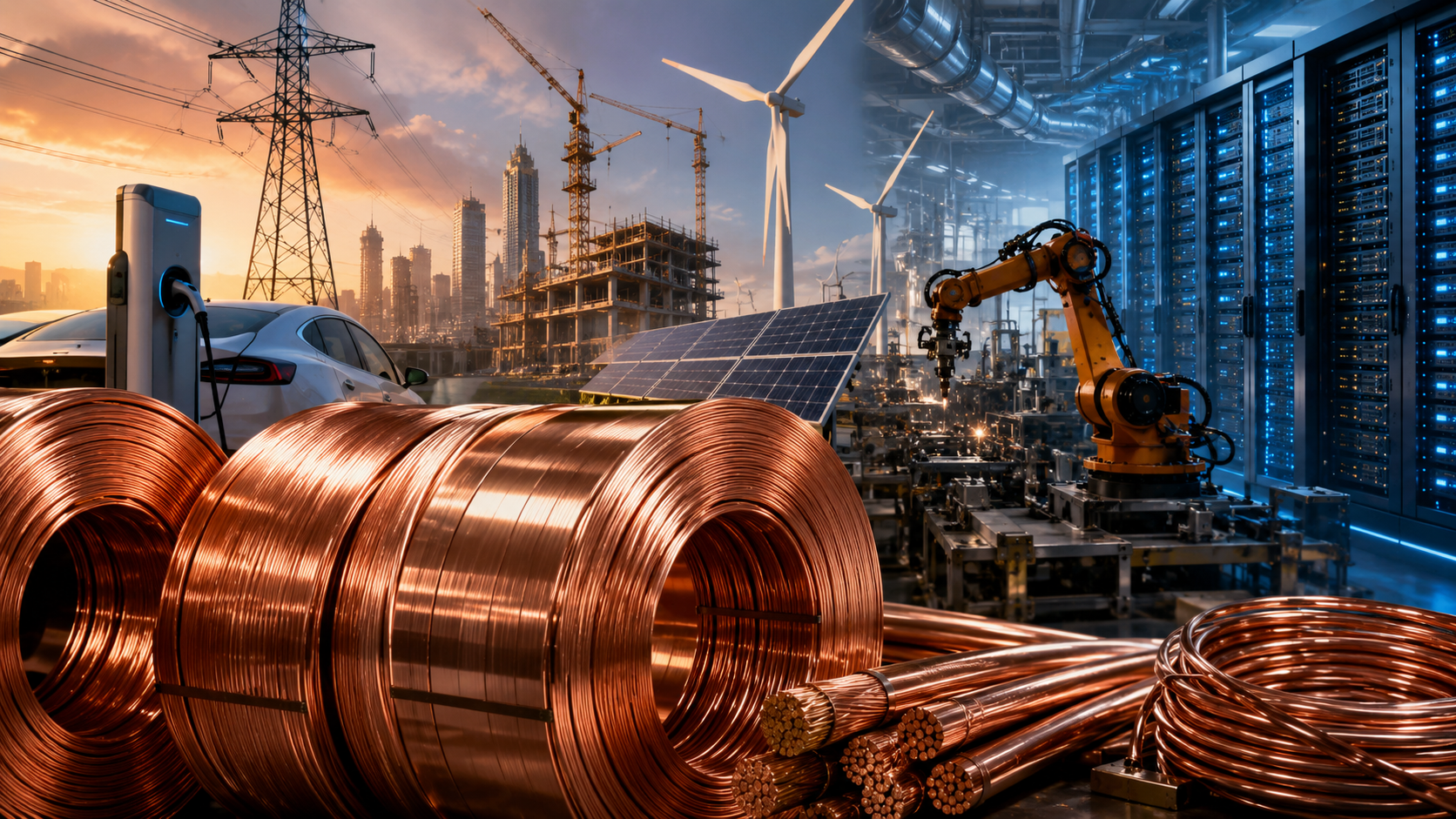
Copper has always been an important industrial commodity, but the next decade could change the way investors look at it altogether. Often called “Dr. Copper” because its demand tends to reflect the health of the global economy, copper sits inside almost everything associated with economic expansion—buildings, electrical wiring, power grids, automobiles, industrial machinery, consumer appliances and telecommunications. What makes the current cycle different is that traditional demand is now being joined by three enormous new consumers of copper: electrification, electric vehicles and artificial intelligence infrastructure. In other words, the world does not simply need more copper because economies are growing; it needs significantly more copper because almost everything is becoming electrical.
The numbers explain the scale of the shift. S&P Global estimates global copper demand could increase from roughly 28 million tonnes in 2025 to around 42 million tonnes by 2040, representing approximately 50% growth in just 15 years. Energy-transition-related copper demand alone is projected to rise from about 8.5 million tonnes in 2025 to 15.6 million tonnes by 2040. Electric vehicles are particularly important because an EV can require roughly three times as much copper as a conventional internal-combustion vehicle. Copper is required in batteries, electric motors, inverters, charging systems and the cabling connecting everything together. The bigger opportunity, however, may be outside the car itself. Millions of EVs need charging infrastructure, which requires stronger distribution networks, transformers, substations and additional electricity generation—all copper-intensive assets. Renewable power adds another layer: solar farms, wind turbines, battery-storage systems and long-distance transmission infrastructure cannot be constructed at scale without enormous amounts of conductive material. S&P estimates global grid expansion and modernization could require more than $7.5 trillion of investment, with copper sitting directly at the centre of that infrastructure build-out.
Then comes AI. Investors normally associate artificial intelligence with semiconductors, GPUs and software companies, but underneath the digital economy sits a very physical infrastructure layer. Data centres require servers, cooling equipment, electrical distribution systems, transformers, backup infrastructure and increasingly enormous connections to electricity grids. Copper is present across that chain. S&P Global estimates copper demand associated with data centres could rise from approximately 1.1 million tonnes in 2025 to 2.5 million tonnes annually by 2040. BHP offers another interesting way to visualise this demand: it estimates that every additional $200 billion of annual data-centre investment could require copper equivalent to the production of a new 150,000-tonne-per-year copper mine for computing hardware and related power infrastructure. BHP expects overall global copper demand to exceed 50 million tonnes annually by 2050, while non-traditional demand from energy transition and digitalisation could grow at a 6.5% CAGR between 2020 and 2035. Suddenly, AI infrastructure does not look like merely a technology story—it becomes a metals, electricity and infrastructure story as well.
For India, the copper opportunity may be even more significant because consumption is starting from a comparatively low base while infrastructure investment remains high. According to the International Copper Association India, India's copper demand increased 9.3% year-on-year to 1.878 million tonnes in FY2025, compared with 1.718 million tonnes in FY2024. Building and construction accounted for roughly 25% of demand, infrastructure around 19%, industrial applications around 17%, consumer goods around 17% and transportation approximately 14%. Demand from building construction grew around 11%, infrastructure 17%, while consumer-durable copper demand increased about 19% as sales of air conditioners, fans and appliances expanded. The long-term numbers are even more interesting. India's Ministry of Mines estimates domestic apparent copper demand could reach approximately 8.8–9.8 million tonnes by FY2047, with per-capita consumption increasing from roughly 1.2 kg in FY2024 to 5.4–6 kg. BHP similarly highlights how much room remains for India's industrialisation story: accumulated copper stock in advanced economies is close to 200 kg per person, compared with only around 15 kg per person in India. Every new residential project, metro network, railway electrification programme, renewable-power installation, data centre, factory, transmission corridor, EV charger and consumer appliance therefore creates incremental demand.
The biggest question for investors is whether supply can grow quickly enough. Copper mines cannot simply be switched on when demand increases. Discovering a commercially viable deposit, receiving environmental approvals, building infrastructure and finally reaching production can take many years, while existing mines simultaneously face declining ore grades and resource depletion. S&P Global projects mined copper production could peak around 25.8 million tonnes in 2030 before declining towards 22 million tonnes by 2040 under its assumptions. Even after including recycled material and potential future projects, its modelling indicates the copper market could face a supply shortfall approaching 10 million tonnes annually by 2040 without major additional investment. BHP also estimates more than 2.5 million tonnes of currently uncommitted mine supply may be required by 2030 simply to maintain market balance. India's own concern over securing future raw materials is already visible: in September 2026, India resumed discussions with Zambia around potential investments in copper and other critical minerals as it looks to strengthen long-term supply security.
The Nivesh Street View
Copper is therefore becoming much more than a cyclical bet on construction or Chinese manufacturing. The commodity sits at the intersection of India's infrastructure expansion, global electrification, renewable energy, electric mobility, AI data centres and grid modernisation. That does not mean copper prices will move upward in a straight line—global recessions, Chinese demand, inventories, currency movements, recycling, substitution and new mining projects can create significant commodity cycles. But the structural equation deserves attention: the global economy wants to consume materially more copper while developing new copper supply remains slow, expensive and increasingly complex.
For retail investors, that makes copper one of the most interesting commodities to track over the next decade. In the world being built around electricity, computing and connectivity, copper is effectively the wiring underneath the entire transformation.