
Hackers Turn Up Supermarket Fridges in France: A Cybersecurity Warning for Businesses Everywhere
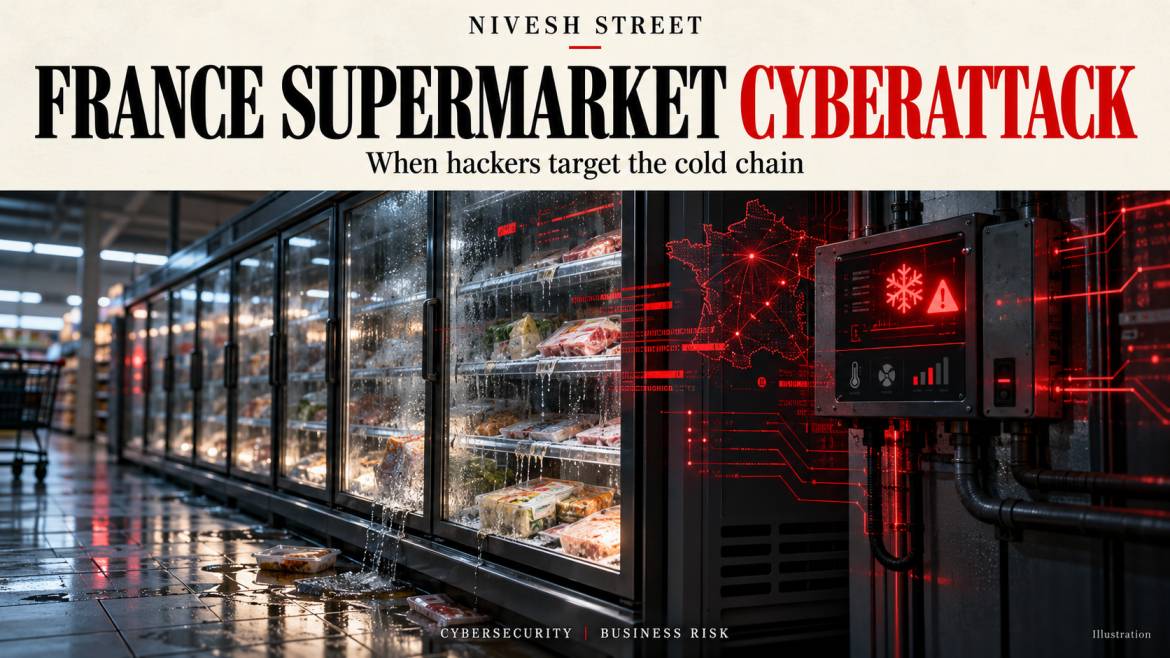
The attack highlights how compromised digital systems can destroy inventory, interrupt essential services and create physical safety risks.
A cyberattack on refrigeration systems at hundreds of French supermarkets reportedly pushed some temperatures to 50°C, spoiling food and triggering fires. Major retailers were affected, and French cybersecurity authorities launched an investigation. Reuters reported that an industry executive estimated nationwide losses could reach tens of millions of euros; a final industry-wide assessment remains unavailable.
For businesses and investors, the incident raises an uncomfortable question: how much physical damage can someone cause by gaining access to a company’s connected equipment?
Cybersecurity failures can reach directly into daily operations. When the compromised system controls refrigeration, the consequences can include unsafe food, destroyed stock and disrupted trading.
Security concerns extend beyond customer data
Much of the public conversation around cybersecurity centres on stolen passwords, payment details and confidential information. This incident illustrates another exposure: the equipment that keeps a business running.
Operational technology includes systems that monitor or control physical processes. In a retailer, that can mean refrigeration. Elsewhere, it can include warehouse equipment, building controls or production machinery.
The business risk is straightforward. If an attacker can interfere with essential equipment, a company could lose the ability to operate safely even while its website and payment systems remain available.
The investigation is still developing
Reuters subsequently reported that France’s cybersecurity agency identified affected refrigeration systems using Danfoss, Copeland and Dixell software. Investigators had not publicly established responsibility for the attack in the reporting reviewed.
Associated Press reported that authorities linked the incidents to weaknesses in outdated remote-control modules and inadequately secured systems exposed to the public internet. Those findings place equipment maintenance and access controls at the centre of the security discussion.
The precise entry method and full financial impact still require investigation. Identifying a vulnerable product does not, by itself, establish exactly how every affected store was compromised.
The financial damage can outlast the attack
From a business perspective, discarded inventory may be only the first cost.
Companies facing a similar disruption could also incur equipment repairs, emergency technical support, replacement stock, interrupted sales and additional logistics expenses. These are potential consequences, rather than confirmed costs across all affected French retailers.
Recovery also requires confidence that systems are safe to reconnect. Restoring access is one task; verifying equipment settings, product safety and operating conditions is another.
For investors, this makes cybersecurity relevant to margins, cash flow and business continuity. A useful assessment should examine how management protects the systems on which revenue depends.
Why Indian retailers and quick-commerce businesses should pay attention
Nivesh Street’s assessment is that the incident offers a practical warning for Indian businesses expanding connected stores, dark stores and cold-chain networks.
Remote monitoring can help companies manage many locations efficiently. It also makes the security of equipment, maintenance providers and remote access increasingly consequential.
Businesses should be able to answer a few basic questions:
Which essential devices can be accessed remotely, and by whom?
Who owns responsibility for firmware updates and replacing unsupported equipment?
Can unusual temperature changes trigger an independent alert?
Can a compromised site or device be isolated quickly?
Have teams practiced operating through an equipment-control failure?
These questions belong in operational reviews and board discussions alongside sales growth and expansion plans.
Cyber resilience is part of business resilience
The French supermarket incident demonstrates that a digital intrusion can produce immediate physical losses.
For companies building increasingly connected operations, cybersecurity deserves the same attention as inventory protection, equipment maintenance and emergency planning. The financial exposure sits wherever a compromised system can interrupt the business.