
India Tier-2 Cities Post 14% Housing Demand CAGR: Where Next
For decades, Indian real estate was largely a story of Mumbai, Delhi-NCR, Bengaluru, Hyderabad, Chennai and Pune. Investors followed employment, developers followed investors, and property prices followed both.
That equation is beginning to change.
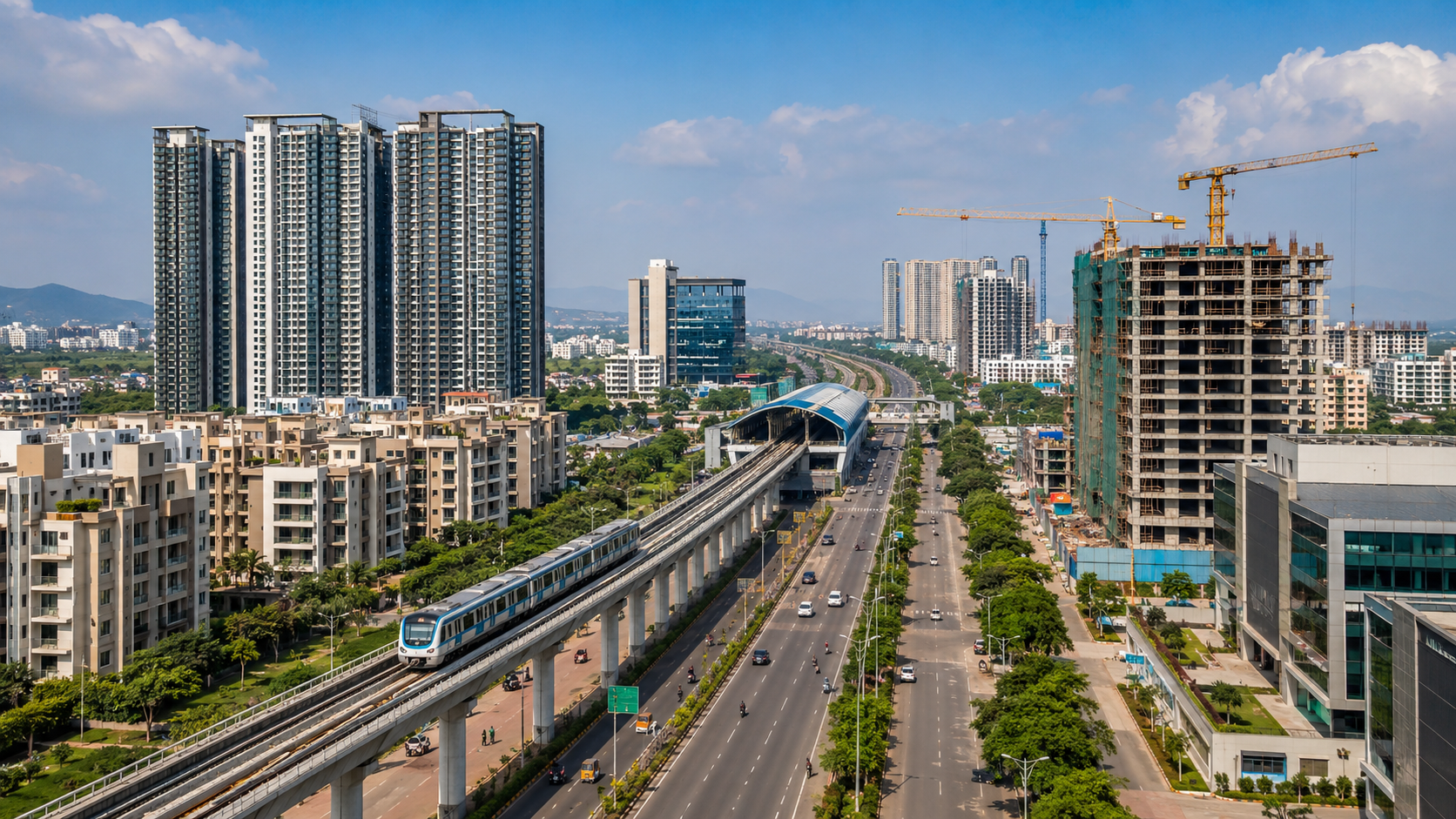
From Lucknow and Indore to Coimbatore, Nagpur, Jaipur, Bhubaneswar, Mohali, Surat, Nashik and smaller emerging urban centres, capital is moving deeper into India. Better highways, airports, industrial corridors, manufacturing investments, expanding service-sector employment and improving urban infrastructure are turning several Tier-2 and Tier-3 markets from relatively local property markets into increasingly organised investment destinations.
The numbers suggest this is no longer merely a post-pandemic trend.
Tier-2 Housing Demand Has Grown at 14% CAGR
One of the strongest recent indicators comes from Crisil Intelligence's July 2026 Housing Hotspots report.
Crisil estimates that residential real-estate demand across a basket of Tier-2 cities grew at a 14% compound annual growth rate between FY2021 and FY2026. More strikingly, markets including Nagpur, Coimbatore and Lucknow recorded demand growth of around 20% CAGR during the period.
The cities covered by Crisil included Bhubaneswar, Coimbatore, Indore, Jaipur, Lucknow, Nagpur, Nashik, Surat, Vadodara and Visakhapatnam.
This is significant because it suggests that housing growth outside India's largest metros is increasingly structural rather than purely speculative. Crisil attributes much of the expansion to infrastructure development and urban growth, while also highlighting stronger home-loan disbursements and a growing preference for larger and premium homes.
But there is another side to the story: rapidly appreciating property values could gradually weaken the very affordability advantage that helped these cities attract buyers in the first place.
Developers Are Following the Demand
Perhaps an even stronger indicator than property prices is where developers are buying land.
A CREDAI-Liases Foras study covering 60 Indian cities found that 44% of the 3,294 acres acquired by real-estate developers during 2024 was located in Tier-2 and Tier-3 markets.
Land acquisition is essentially a developer's long-term bet.
When developers acquire hundreds of acres in emerging markets, they are not simply betting on today's apartment sales. They are making a multi-year call on population growth, household incomes, infrastructure, employment and future urbanisation.
Institutional capital is beginning to notice the same opportunity.
According to a CBRE-CII study, Tier-2 cities attracted approximately $3 billion of real-estate equity investment between 2022 and 2024, representing almost 10% of India's overall real-estate equity investments during the period. Around 47% of Tier-2 investment went into land and development sites, while industrial and logistics assets accounted for roughly another 25%.
That composition matters.
It indicates investors are not merely acquiring finished buildings. Significant capital is being deployed toward building the next generation of residential, logistics and commercial ecosystems.
The ₹1 Crore Home Is No Longer Just a Metro Phenomenon
There is also a major change taking place in what consumers in smaller cities are buying.
Tier-2 real estate was historically associated with affordable housing. Increasingly, that description is incomplete.
PropEquity data for India's top 15 Tier-2 cities showed that housing sales volumes declined 10% year-on-year in 2025 to around 1.56 lakh units, while total sales value remained broadly unchanged at approximately ₹1.48 lakh crore.
At first glance, falling transactions might appear negative.
But underneath the headline numbers is a notable shift.
Sales of homes priced below ₹1 crore declined approximately 15%, while sales of homes priced above ₹1 crore increased around 9%. The ₹1 crore-plus category consequently increased its share of Tier-2 housing sales from 23% in 2024 to 28% in 2025.
In other words, Tier-2 housing is slowly moving from an affordability-only story toward an aspiration and premiumisation story.
Larger apartments, gated communities, clubhouses, branded developments and integrated townships that were once concentrated in metropolitan markets are increasingly appearing in smaller cities.
A broader CREDAI-Liases Foras study covering 50 Indian cities reinforces this trend. India's primary residential market recorded approximately ₹8.46 lakh crore of sales in 2025, up 16% in value terms from 2024, with premium housing increasingly dominating overall transaction value. CREDAI specifically noted that Tier-2, Tier-3 and Tier-4 markets are becoming more important to India's next phase of urban housing growth.
Why Is This Shift Happening?
There isn't one single trigger.
Infrastructure is compressing distance
Expressways, metro projects, upgraded railway infrastructure, new airports and industrial corridors are increasingly connecting smaller cities to major economic centres.
A location that once appeared geographically isolated can become investable very quickly when travel time to an employment or industrial hub falls sharply.
Manufacturing is moving beyond metros
India's push towards domestic manufacturing, electronics, automobiles, defence, renewable energy, logistics and industrial corridors is creating employment clusters outside traditional IT-heavy metropolitan centres.
Manufacturing-led cities behave differently from speculative real-estate markets because employment can create recurring demand for both residential and commercial property.
The internet has democratised consumption
Income aspirations in Jaipur, Indore or Lucknow are increasingly similar to those in major metros.
Consumers have access to the same brands, financial products, entertainment and e-commerce platforms. Consequently, expectations around housing quality, retail, restaurants, offices and lifestyle infrastructure have risen sharply.
Metro affordability has deteriorated
When similar-sized homes in India's largest cities require dramatically higher capital commitments, buyers naturally begin evaluating emerging cities—particularly individuals who can work remotely, operate businesses locally, are returning to their hometowns or are investing with a longer horizon.
The Commercial Opportunity Is Just Beginning
Residential housing is only one part of the Tier-2 story.
Warehousing, hotels, hospitals, retail centres, data centres, flexible offices, educational infrastructure and industrial facilities are increasingly moving beyond metropolitan markets.
CBRE notes that rapid industrialisation, increasing consumption and infrastructure expansion have made Tier-2 cities increasingly attractive for institutional capital, with industrial and logistics assets already accounting for around a quarter of Tier-2 equity investments between 2022 and 2024.
There could also be a longer-term employment catalyst from India's expanding Global Capability Centre ecosystem.
JLL reported that GCCs leased a record 31 million sq. ft. of office space in India during 2025, while identifying Tier-2 markets as potential new frontiers for future GCC expansion.
Even a relatively small migration of technology, operations, analytics and back-office employment towards cities such as Coimbatore, Jaipur, Indore or Bhubaneswar could have disproportionate effects on local residential demand because these property markets are substantially smaller than Bengaluru or Hyderabad.
But Not Every Tier-2 City Will Become the Next Gurgaon
This is perhaps the most important point for investors.
Tier-2 real estate should not be treated as a single asset class.
The 2025 numbers already show enormous differences between cities.
According to PropEquity, Mohali recorded 34% growth in housing sales during 2025 and Lucknow grew around 6%, while Visakhapatnam declined 38%, Bhubaneswar dropped 25%, Vadodara fell 19%, Nagpur declined 18% and Kochi declined 17%.
That divergence should eliminate the idea that simply purchasing property in a smaller Indian city guarantees superior returns.
In real estate, the micro-market can matter more than the city.
A property located near an operational industrial cluster, major university, business district, airport or infrastructure corridor can behave very differently from speculative plots situated kilometres away from actual economic activity.
Investors therefore need to distinguish between infrastructure that has been announced and infrastructure that has actually been funded, constructed or commissioned.
What Should Investors Look For?
Rather than searching for the "next Bengaluru", investors evaluating Tier-2 and Tier-3 property should study five factors together:
Employment creation: Are companies actually creating jobs in the region?
Infrastructure execution: Are airports, highways, metros and industrial projects operational or merely proposed?
Developer quality: Has a credible developer entered the market, and does the project have strong RERA and delivery credentials?
Rental depth: Is there genuine rental demand from professionals, students, industrial employees or businesses?
Supply discipline: Are developers launching housing faster than the city's population and employment ecosystem can absorb it?
Property appreciation supported by these fundamentals can potentially sustain itself.
Price appreciation driven mostly by investor-to-investor transactions is considerably more vulnerable.
The Nivesh Street View
India's Tier-2 and Tier-3 real-estate opportunity appears to be entering a fundamentally different phase.
The strongest evidence isn't simply that prices are increasing. It is that developers are acquiring land, institutional capital is entering emerging cities, premium housing demand is rising, infrastructure is expanding and businesses are slowly decentralising beyond traditional metropolitan centres.
Crisil's finding of 14% residential-demand CAGR across Tier-2 cities between FY2021 and FY2026, combined with nearly 44% of developer land acquisitions in 2024 occurring across Tier-2 and Tier-3 markets, offers compelling evidence of this structural shift.
However, the 10% decline in Tier-2 housing volumes during 2025 also sends an important warning: prices cannot permanently outrun household purchasing power.
India may therefore not experience one uniform Tier-2 real-estate boom.
Instead, the next decade could produce a handful of major winners—cities where employment + infrastructure + population + organised development + affordability converge at the right time.
Finding those cities before that convergence becomes obvious may represent one of the more interesting real-estate opportunities in India's next phase of urbanisation.
Disclaimer: This article is for informational and educational purposes only and should not be considered investment advice. Real estate investments involve liquidity, regulatory, execution, financing and market risks. Investors should conduct independent due diligence before making investment decisions.