
India Tokenizes ₹1025 Crore of Corporate Bonds Goes Digital
India has spent years taking a cautious approach to cryptocurrencies. But when it comes to blockchain as financial infrastructure, the country is moving in a very different direction. SEBI and the Reserve Bank of India have now launched one of India’s most significant experiments in tokenised finance — and unlike speculative crypto assets, this one sits directly inside the regulated securities system.
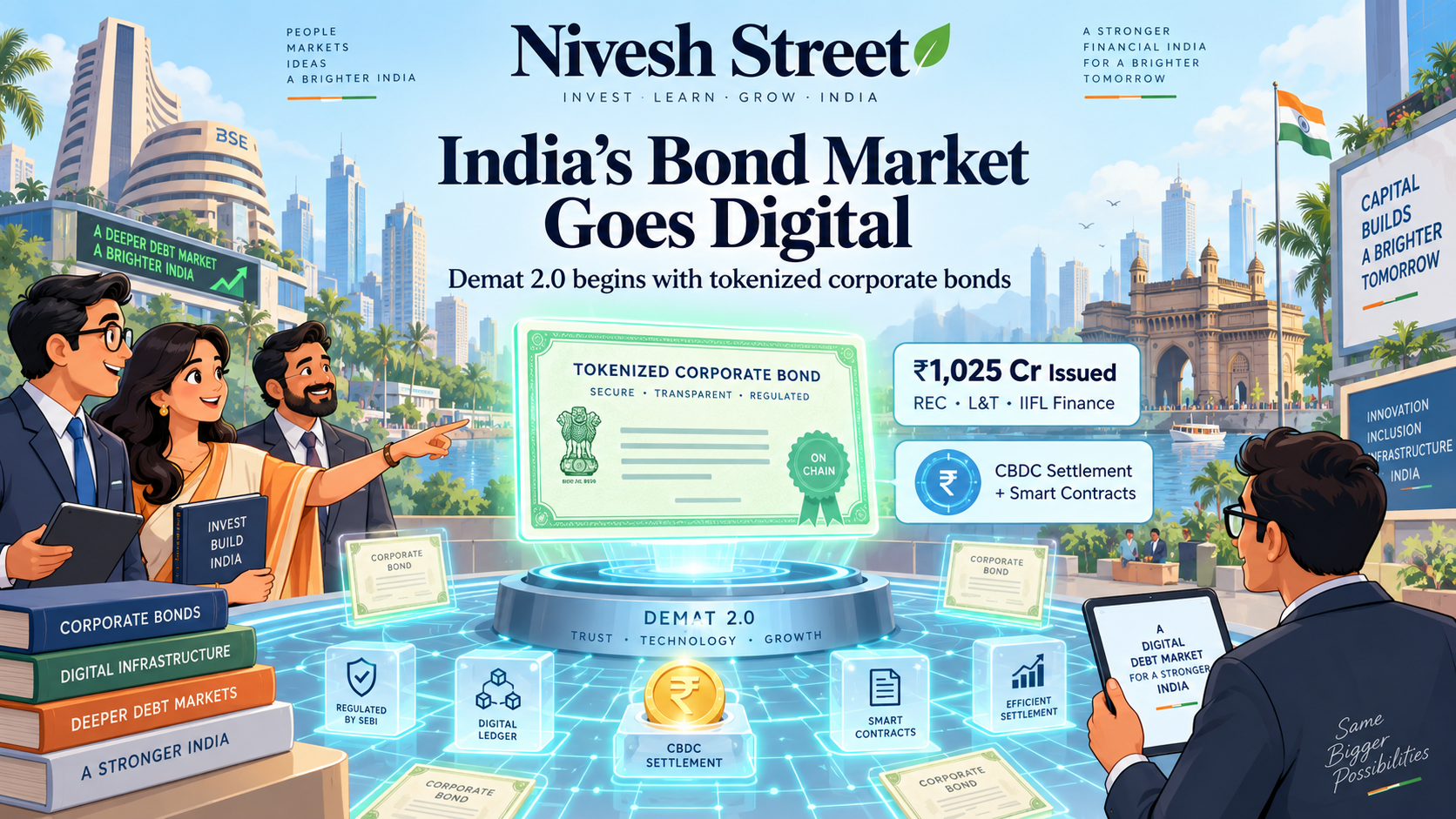
India’s Demat 2.0 pilot has begun with three companies issuing a combined ₹1,025 crore, or roughly $107 million, of tokenised corporate bonds. State-owned REC raised ₹500 crore from 18 investors, Larsen & Toubro raised another ₹500 crore from four investors, while IIFL Finance issued ₹25 crore to a single investor. The bonds are issued as native digital tokens using distributed ledger technology, while payments are settled using the RBI’s wholesale central bank digital currency. SEBI says this makes India the first country to combine natively tokenised bonds, statutory depository ownership records and CBDC settlement within the existing regulated securities-market framework.
This Is Not Crypto — It Is Demat Being Rebuilt
The word “tokenisation” can make the development sound like India is suddenly embracing crypto markets. That is not what is happening. SEBI makes an important distinction: the token itself is the corporate bond. The legal rights of the investor, coupon, maturity, ISIN, issuer obligations, credit rating and regulatory treatment remain unchanged. What changes is the infrastructure underneath the security. Instead of ownership being recorded only through a conventional centralised database, the bond exists on a private, permissioned distributed ledger controlled by India’s regulated market infrastructure institutions.
That difference is critical. India is not trying to replace NSDL, CDSL, exchanges or the banking system with an anonymous public blockchain. The depositories continue to remain the authoritative record keepers, existing securities regulations continue to apply and investors do not even have to manage private keys themselves. Demat 2.0 becomes an extension of the investor’s existing demat account, existing KYC remains valid and the depositories manage the cryptographic infrastructure in the background. In other words, the investor experience is designed to remain familiar while the settlement architecture underneath it changes significantly.
What Actually Changes for the Bond Market?
The biggest improvement is settlement. Under the traditional system, securities and money can move through separate processes involving intermediaries, reconciliation and settlement delays. Under Demat 2.0, tokenised bonds are linked directly to the RBI’s digital rupee through atomic Delivery-versus-Payment. Either the bond and money move simultaneously, or neither transaction happens. This removes the window during which one party may have delivered an asset while still waiting to receive payment. SEBI says issuers can consequently receive funds on the same day as bidding instead of waiting two to three days, while smart contracts can automate coupon payments, redemption and other corporate actions.
Consider what that means at scale. India's corporate bond market involves issuers, investors, exchanges, depositories, banks, trustees, clearing infrastructure and multiple reconciliation processes. Each additional operational layer creates cost, time and the possibility of errors. Tokenisation does not eliminate the need for regulation or intermediaries, but it could significantly reduce the amount of repetitive reconciliation between them. Corporate actions that today require instructions and verification across multiple systems could eventually be triggered automatically based on the ownership recorded on the ledger.
REC, L&T and IIFL Are Testing Three Different Parts of the Market
The first issuances are also more interesting than the headline ₹1,025 crore suggests because they involve different kinds of borrowers. REC raised ₹500 crore through a 20-month bond carrying a 7.3% coupon. L&T raised ₹500 crore through a three-year bond at 7.4%, while IIFL Finance raised ₹25 crore through a two-year bond at 9.1%. L&T became the first major private-sector corporate participant, while IIFL demonstrated that the infrastructure can also extend beyond PSU-linked issuers into the NBFC market.
The pilot was originally expected to begin much more narrowly. Reports in August indicated that REC would issue less than ₹500 crore to a select group of investors. The eventual launch involved three issuers and more than doubled the initially expected size, suggesting regulators were willing to test the infrastructure across a wider range of issuers from the beginning.
But ₹1,025 crore remains tiny compared with the overall Indian debt market. Investors should therefore view this as market-infrastructure testing rather than a new asset class suddenly reaching scale. The real question is whether the system can eventually process tens or hundreds of thousands of crores while remaining secure, liquid and interoperable with India's existing financial infrastructure.
Retail Investors Could Be the Bigger Story
For now, participation is primarily institutional, but SEBI has already outlined a three-stage roadmap. Stage I focuses on issuance and holding of tokenised corporate bonds. Stage II is expected to introduce secondary-market trading and extend access to retail investors, while Stage III could allow more regulated entities to operate nodes and potentially expand tokenisation to other financial instruments. Existing RFQ and OTC platforms will remain the venues for trading rather than India creating a separate “crypto-style” token exchange.
This is where Demat 2.0 could eventually become much more significant. India's corporate bond market has historically been dominated by institutional investors, while retail participation remains relatively limited compared with equities and mutual funds. Tokenisation alone will not solve problems such as low liquidity, limited awareness or credit risk, but a more efficient digital infrastructure could eventually make bond ownership, settlement and servicing simpler. If tokenisation is later combined with smaller investment denominations and deeper secondary-market liquidity, retail access to fixed-income markets could improve substantially.
There is also an important point that should not be overlooked: tokenisation does not remove credit risk. If an issuer defaults, owning the bond as a blockchain token does not make the investor whole. The rating, financial health and repayment capability of the borrower remain exactly as important as before. Blockchain can improve how ownership and payments are recorded; it cannot turn a weak borrower into a strong one.
The Digital Rupee May Finally Get a Serious Use Case
The pilot is equally important for the RBI’s CBDC strategy. Central banks around the world have spent years experimenting with digital currencies, but the biggest challenge has always been finding applications that meaningfully improve on existing payment systems. India already has UPI, one of the world's most efficient retail-payment networks, making the argument for a retail CBDC less obvious to the average consumer.
Wholesale markets are different. Connecting tokenised securities directly to central-bank money could materially reduce settlement risk and create a clearer institutional use case for the digital rupee. Participants in Demat 2.0 require a wholesale CBDC wallet with a participating bank, allowing the securities leg and cash leg of a bond transaction to settle together.
That architecture could eventually become relevant beyond corporate bonds. Government securities, commercial paper, certificates of deposit, securitised assets and potentially other regulated financial instruments could theoretically use similar rails if the pilot proves successful. SEBI itself says later phases may consider additional instruments.
Why India’s Approach Is Particularly Interesting
India's approach to blockchain is gradually becoming clearer: restrict speculative excess, but use the underlying technology where it can make regulated finance more efficient. Instead of pushing securities onto public blockchains and then attempting to regulate them afterwards, India is doing almost the reverse. Existing laws, exchanges, depositories, KYC, investor protections and central-bank money remain in place, while distributed-ledger technology is inserted underneath them.
That could ultimately prove more relevant to mainstream finance than many of the blockchain experiments of the previous decade. Banks and institutional investors generally do not require financial markets to become anonymous or decentralised. They want transactions to become cheaper, faster, safer and easier to audit. A permissioned system operated by regulated institutions can potentially deliver some of blockchain’s efficiency benefits without abandoning the legal infrastructure on which institutional finance depends.
There are still major questions. Secondary-market liquidity must develop. Conventional Demat and Demat 2.0 systems need to work together smoothly. Cybersecurity and operational resilience become critical once large values move through smart contracts. Regulators will also need to determine whether the efficiency advantages remain meaningful once the infrastructure is operating at commercial scale. Market participants have already highlighted liquidity, interoperability, cybersecurity and the ability to transfer between conventional and tokenised systems as areas that must be resolved before broader adoption.
Nivesh Street View
India's ₹1,025 crore tokenised bond pilot matters far more because of the infrastructure being created than because of the money raised. ₹1,025 crore is insignificant beside India's overall capital markets, but the combination of tokenised securities, regulated depositories, smart contracts and RBI-issued digital currency provides a glimpse of what India's financial markets could look like a decade from now.
The biggest mistake would be viewing this purely as another “blockchain story.” Demat accounts themselves transformed Indian markets by replacing physical share certificates with electronic ownership. Demat 2.0 is essentially asking whether the next transformation can remove some of the remaining friction between ownership, trading and settlement.
If the experiment works, India may not need to create a parallel digital-asset market. The existing market itself can become digital at a much deeper level.
Nivesh Street Bottom Line
India is not putting bonds on blockchain because blockchain is fashionable. It is testing whether ₹1,000 crore today can become a faster, programmable and more efficient trillion-dollar debt market tomorrow.
The important innovation is not that REC, L&T or IIFL issued a “token.” It is that a regulated corporate bond can now be issued on distributed-ledger infrastructure, held inside an existing demat relationship and settled directly against central-bank digital money without changing the investor's fundamental legal protections.
Crypto tried to build a new financial system outside traditional finance. India's Demat 2.0 experiment is doing something potentially more powerful: bringing the technology inside the financial system that already exists.
This article is for informational and educational purposes only and does not constitute investment advice.