
Indias 2026 Market Crash Is Quietly Building Tomorrows Bull Run
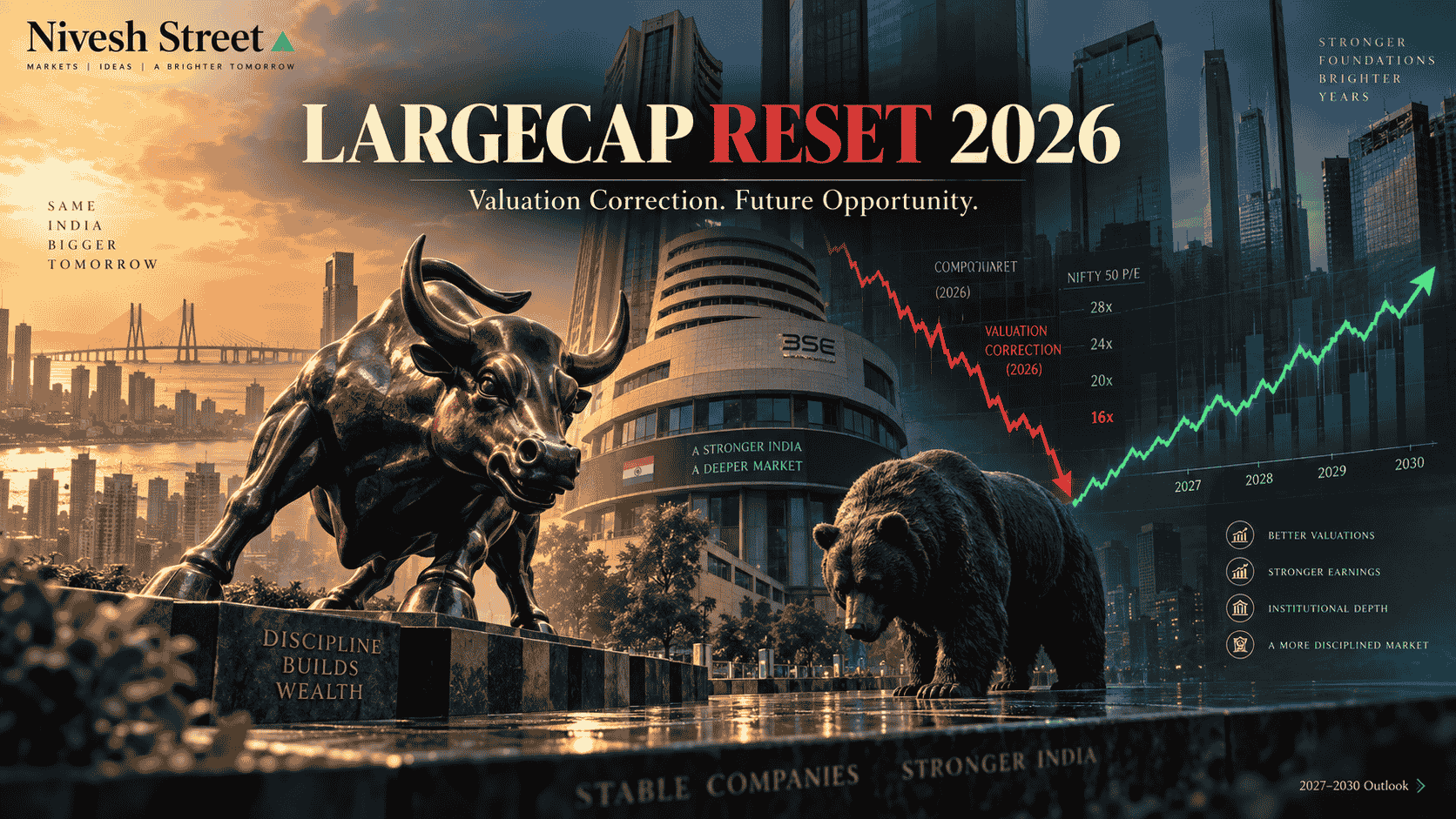
For years, the biggest argument against Indian equities was not growth, governance or opportunity. It was valuation. In 2026, the market may finally be correcting that problem.
India’s large-cap market has gone through a meaningful reset in 2026. The Nifty 50 closed at 23,398 on September 11 after five consecutive weeks of declines, with the index losing nearly 4.8% in just five weeks as expensive crude oil, rising global yields and geopolitical uncertainty pressured equities. But underneath this decline is something potentially far more important for long-term investors: valuations are becoming considerably more reasonable. In early August, the Nifty 50 was trading at roughly 19.1 times one-year forward earnings, marginally below its 10-year average, after years when investors regularly complained that India's growth story was already priced into stocks. The question therefore is no longer simply, “Why are large caps falling?” The more important question is: Could the 2026 valuation correction actually improve Indian market returns over the next several years?
India Is Correcting Price, Not Necessarily Growth
That distinction matters because the economic backdrop has not deteriorated in the same way as equity prices. India's economy expanded 7.8% year-on-year in the April-June 2026 quarter, supported by strong consumption, manufacturing and private investment, while bank credit growth accelerated sharply. Corporate profitability has also surprised positively. Nifty 50 companies reported roughly 11% year-on-year profit growth during the first quarter earnings season, running ahead of expectations, while Kotak Institutional Equities projected full-year index profit growth of around 18%. In other words, 2026 has so far looked less like an earnings collapse and more like a valuation de-rating. That can be painful for investors holding stocks purchased at expensive multiples, but it is fundamentally different from a market where company profits themselves are collapsing.
This is how valuation corrections work. Imagine a company earning ₹100 per share and trading at 25 times earnings; the market values it at ₹2,500. If earnings increase to ₹110 but investors are now willing to pay only 20 times earnings, the share price falls to ₹2,200 despite the company becoming more profitable. The business has grown 10%, but the stock has declined 12%. That gap between business performance and market performance is exactly why valuation matters so much. Indian large caps spent several years carrying a premium because investors were willing to pay heavily for India's growth visibility, political stability, domestic consumption and demographic opportunity. In 2026, higher global interest rates, expensive oil and foreign capital outflows have forced investors to reconsider how large that premium should be.
Why This Correction Could Actually Be Healthy
Markets ultimately need earnings and valuations to reconnect. If share prices continuously rise faster than corporate profits, future returns are simply being pulled forward. Investors feel wealthier during the rerating phase, but each additional increase in valuation reduces the margin of safety available to the next buyer. A correction reverses that process. Prices fall or remain stagnant while earnings continue growing, bringing the price-to-earnings ratio back towards more sustainable levels. This is painful in the short term but potentially constructive for long-term returns because investors buying after the reset are paying less for every rupee of future corporate profit.
The mathematics of future returns therefore becomes considerably healthier. When investors purchase a market at extreme valuations, they require both earnings growth and continued willingness from future investors to pay an equally expensive multiple. When valuations normalise, future returns can increasingly be generated through the underlying growth of earnings themselves. If Indian large-cap earnings were eventually to compound at, say, 10–15% annually while valuations remained broadly stable, the market would no longer require significant P/E expansion to generate attractive long-term returns. That does not mean investors should expect 10–15% index returns automatically—earnings growth, dividends, changing index composition and valuation movements all matter—but it means the dependency on speculative multiple expansion becomes much smaller.
2026 May Be Creating a Large-Cap Valuation Opportunity
There is another interesting development occurring underneath the market. Investors have continued pouring money into mid- and small-cap funds even while large-cap funds have experienced withdrawals. In August, Indian equity mutual funds received ₹293.29 billion of net inflows and SIP contributions reached a record ₹322.97 billion, yet large-cap funds recorded ₹11.47 billion of outflows for the second consecutive month. Mid-cap funds received ₹69.89 billion and small-cap funds ₹79.73 billion. The implication is worth watching. Large caps are correcting while substantial domestic liquidity continues flowing towards smaller companies. If that divergence continues, the relative valuation attractiveness of high-quality large caps could improve significantly.
This does not automatically mean smallcaps must crash or that large caps will immediately outperform. It means the risk-reward equation is changing. Large companies generally offer stronger balance sheets, deeper liquidity, more diversified businesses and greater institutional ownership. When those companies also become available at lower valuation multiples, investors receive a combination they rarely get during euphoric markets: quality plus a better entry price. In fact, current research has increasingly highlighted large caps as relatively more attractive after the correction, particularly compared with portions of the mid- and small-cap universe that continue to command sizeable valuation premiums.
What This Could Mean for 2027–2030
The biggest impact of the 2026 correction may not become visible in 2026 itself. It could appear during the years that follow. First, future returns may become more earnings-driven. Instead of investors relying on a stock moving from 25 times earnings to 35 times earnings, returns can increasingly come from companies actually increasing profits, cash flows and dividends. That generally creates a more durable market structure. Second, India's relative attractiveness to global investors could improve. Foreign investors have withdrawn substantial amounts from Indian equities in 2026, partly because India entered the year with expensive valuations relative to several emerging-market alternatives. Reuters reported foreign outflows of around $24 billion by early September despite strong domestic growth. As India's valuation premium narrows while corporate earnings recover, the argument for international capital to reconsider India becomes stronger.
Third, the correction could create a rotation back towards large caps. The past few years conditioned investors to believe that greater risk automatically produced greater returns, encouraging flows towards smaller companies. Markets rarely allow that relationship to persist indefinitely. If large-cap earnings continue growing while valuations compress, the relative return potential begins improving without requiring investors to take the same level of liquidity and business risk associated with smaller companies. Foreign institutional investors returning to India would reinforce this trend because global funds typically deploy the majority of large allocations into liquid index heavyweights rather than small companies.
Fourth, a valuation reset can increase the potential lifespan of the next bull market. A bull market beginning from reasonable valuations has significantly more room for earnings growth and eventual rerating than a bull market beginning from already extreme multiples. India's structural story—formalisation, digitalisation, infrastructure expenditure, manufacturing, financialisation of savings, rising consumption and credit growth—does not disappear because the Nifty corrects for a year. What changes is the price investors are paying to participate in that story. The cheaper that participation becomes without a corresponding collapse in fundamentals, the more favourable the long-term starting point potentially becomes.
But There Is One Important Condition: Earnings Must Deliver
A lower P/E ratio alone does not make a market cheap. Valuations become attractive only when the earnings underneath them are sustainable. A stock trading at 18 times earnings can still be expensive if profits subsequently fall 30%. This is why the next several quarters will be critical for India. So far, corporate earnings have proved resilient, but external risks remain significant. Brent crude moved above $100 per barrel in September, global bond yields have risen and India remains highly dependent on imported energy. If higher oil prices create persistent inflation, weaken consumption or force tighter monetary policy, earnings estimates could eventually be reduced. In that scenario, large-cap valuations could correct further before finding a durable floor.
Investors should therefore avoid interpreting 19 times earnings as some magical number below which the Nifty becomes automatically cheap. Valuation must always be viewed relative to earnings growth, interest rates, bond yields and alternative investment opportunities. If global risk-free rates remain structurally higher than during the 2015–2021 period, Indian equities may deserve lower valuation multiples than investors became accustomed to during the era of extraordinarily cheap global money. The market can therefore become fundamentally attractive without necessarily returning quickly to previous peak P/E multiples.
Nivesh Street View
We believe the most important development in Indian markets during 2026 may ultimately be the normalisation of large-cap valuations, not the fall in the Nifty itself. For years, investors wanted India's growth story but complained about the price they had to pay for it. The market is now beginning to solve that problem. A Nifty trading closer to historical valuation ranges while corporate profits recover is fundamentally more interesting for a long-term investor than a Nifty making record highs primarily because investors are paying increasingly higher multiples for the same earnings.
The next Indian bull cycle may therefore look very different from the previous one. Returns could become more dependent on earnings delivery, free cash flow and capital efficiency, while companies relying purely on narrative and valuation expansion may struggle. Large caps that spent 2026 correcting could gradually regain institutional attention, particularly if foreign flows return and the valuation gap versus mid- and small-cap companies becomes difficult to ignore. The strongest opportunity may eventually emerge not from predicting the exact bottom of the Nifty but from identifying companies where earnings continue growing while valuation multiples are falling. That combination quietly increases future expected return potential.
Nivesh Street Bottom Line
2026 may look disappointing on an investor's one-year return screen, but valuation corrections are often where future returns are created. When prices decline while the underlying economy and corporate profits continue expanding, investors effectively get an opportunity to buy the same long-term growth story at a lower price. India still carries risks—oil, inflation, global rates, currency pressure and earnings execution—but the large-cap market entering the next few years at more reasonable valuations would be considerably healthier than entering them from euphoric multiples.
The paradox of 2026 could therefore be simple: a weaker Nifty today may be exactly what Indian large caps needed to create stronger return potential tomorrow.
Market information referenced through September 11, 2026. This article is for informational and educational purposes and does not constitute investment advice.