
Noida Real Estate Market 2026: Investment Opportunities and Future Outlook
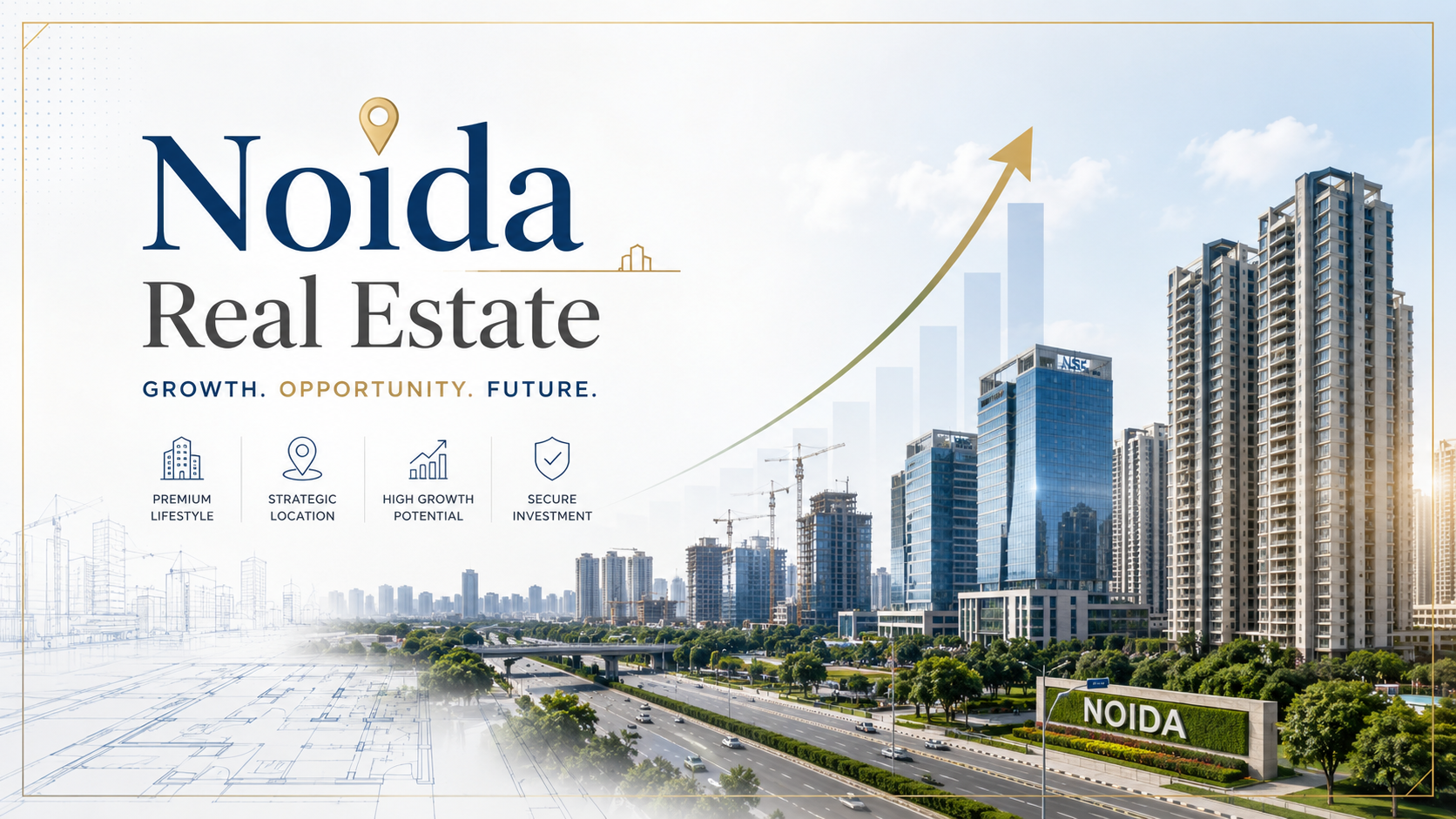
For years, Noida was viewed primarily as a more affordable alternative to Delhi and Gurugram. That perception has changed significantly. Today, Noida is emerging as one of the most important residential and commercial real estate markets in Delhi-NCR, supported by infrastructure development, corporate expansion, improving connectivity, and a strong shift toward premium housing.
The post-2020 period has been particularly strong for property prices in Noida and Greater Noida. Residential prices across several micro-markets have risen sharply, while buyer interest has also shifted from affordable and mid-income apartments toward premium and luxury housing. Larger apartments, low-density developments, branded residences, landscaped communities, and high-end amenities are becoming increasingly common, especially along the Noida-Greater Noida Expressway corridor.
One of the biggest structural developments for the wider Noida region has been the Noida International Airport at Jewar. The airport is expected to significantly influence the economic development of the Yamuna Expressway and Greater Noida region. However, an airport alone does not automatically make every nearby property attractive. The real value comes from the larger ecosystem that develops around it, including roads, logistics, warehousing, offices, employment, housing, retail, and hospitality.
The Noida-Greater Noida Expressway is also becoming one of the most important real estate corridors in NCR. It benefits from connectivity with established Noida, Greater Noida, corporate offices, and the Yamuna Expressway region. Sectors such as 128, 132, 137, 143, 150, and nearby locations have attracted strong residential and commercial activity. Sector 150, in particular, has gained attention as a premium residential micro-market because of its lower-density development, open spaces, and large-scale residential projects.
Another major factor supporting Noida’s real estate market is commercial growth. Technology companies, IT-BPM firms, global corporations, flexible workspace operators, and professional-services companies have expanded their presence across the region. This matters because sustainable residential demand depends heavily on employment generation. More offices create more jobs, more jobs create rental demand, and rental demand eventually supports both property prices and home ownership.
A healthy real estate market cannot depend only on investors buying from other investors. It needs people who actually want to live, work, and spend money in the city. Noida is increasingly developing that foundation.
Premiumisation is another major trend reshaping the market. Buyers today are not evaluating projects only on price per square foot. They are increasingly looking at project density, developer reputation, clubhouse facilities, open spaces, apartment size, construction quality, accessibility, community profile, maintenance standards, and overall livability. This has given developers room to launch significantly more expensive projects than would have been possible in Noida a decade ago.
At the same time, buyers should remain cautious. The sharp appreciation seen since 2020 cannot automatically be expected to continue at the same pace forever. After several years of rapid price growth, some micro-markets may experience consolidation while incomes, rents, infrastructure, and actual end-user demand catch up with valuations.
The biggest mistake an investor can make is assuming that prices will continue rising simply because they have already risen. That is speculation, not analysis.
Noida’s future real estate opportunity can broadly be divided into three zones. Established Noida continues to benefit from developed infrastructure, schools, hospitals, offices, markets, and metro connectivity. Supply in many established sectors is relatively limited, which can support prices in desirable locations.
The Noida-Greater Noida Expressway represents a more modern residential and commercial growth corridor. It may appeal especially to buyers looking for newer high-rise developments, larger apartments, premium amenities, and proximity to corporate offices.
The Yamuna Expressway and Jewar region represent a longer-term investment story. The airport, industrial development, logistics infrastructure, and planned urban development could create significant economic activity over the next decade. However, this region requires patience because development is spread across a much larger geography and not every project will benefit equally.
Investors should also understand the difference between apartments and plots. Apartments can provide rental income and benefit from established communities and amenities. Plots, on the other hand, provide direct land ownership and may offer higher long-term appreciation in developing areas, but generally provide little or no immediate rental income.
The choice therefore depends heavily on the investor’s time horizon. Someone investing for two years should evaluate the market differently from someone willing to hold property for ten or fifteen years.
Despite the positive outlook, individual project selection remains critical. Buyers should independently verify UP RERA registration, land title, approvals, construction status, developer track record, possession timelines, maintenance structure, and the financial health of the project before purchasing.
Noida’s biggest long-term advantage is that it is gradually becoming more than just a residential suburb of Delhi. The region now combines residential housing, IT parks, corporate offices, manufacturing, data infrastructure, expressways, metro connectivity, airport infrastructure, logistics, and retail development.
This ecosystem gives Noida something more valuable than short-term speculation: a genuine economic reason for people and businesses to remain in the region.
The Noida real estate story remains compelling, but the next phase is likely to be more selective. Projects with strong locations, credible developers, genuine infrastructure advantages, and real end-user demand could continue performing well. Projects that depend mainly on marketing narratives may struggle to justify increasingly expensive valuations.
For homebuyers, Noida today offers considerably better infrastructure, connectivity, employment opportunities, and housing choices than it did a decade ago. For investors, the opportunity remains significant, but simply buying property in Noida is no longer enough.
Choosing the right location, project, developer, and entry price will matter far more.
The winners of the next real estate cycle may not simply be those who bought property in Noida. They may be those who correctly identified where infrastructure, employment, businesses, and people would eventually converge.
That is what makes the Noida real estate market one of the most interesting real estate stories to watch in India in 2026.