
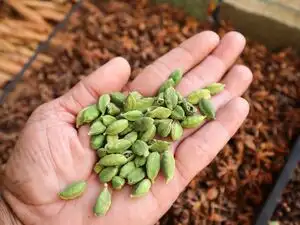
Cultivation of large cardamom emerges as a lucrative option for higher income from limited land
 Agencies
Bilaspur (HP): Farmers can generate additional income through the cultivation of large cardamom, provided they have access to sufficient water, said Deputy Director, Agriculture, Kulbhushan Dhiman on Sunday.
This crop is not damaged by wild animals or birds, offering significant relief to farmers. Furthermore, he said, large cardamom fetches good prices in the market.
For farmers, adopting alternative crops alongside traditional farming to generate higher income from limited land is becoming a necessity. Prem Lal Thakur, a farmer from Karot village in Himachal's Bilaspur district, has become an inspiration for others by cultivating large cardamom for the past 20 years.
Dhiman said that the department, in collaboration with farmer Prem Thakur, will work to involve other farmers in this initiative, aiming to create additional income streams and strengthen the farmers' economic standing. Initially, Prem Thakur cultivated it on a small plot, but given the excellent yields and favourable market prices, he has gradually expanded the area under cultivation.
Farmers who have access to adequate and regular irrigation can increase their income by adopting this crop.
Speaking about his experience, Thakur said that he produces an average of 2 to 3 quintals of large cardamom annually' grown using natural methods' on about one bigha of land, and it fetches a good price in the market. Currently, large cardamom is fetching a price of approximately Rs 1.80 lakh per quintal, which translates to Rs 1,800 per kilogram.
Consequently, this crop can serve as a viable income source for farmers' especially in regions where the yield of traditional crops is relatively low' as large cardamom can be cultivated by leveraging available local resources.
Explaining the cultivation technique, Prem Thakur said that the plants are spaced approximately three feet apart. He emphasises that the availability of water is crucial for the proper growth of the plants and for achieving a better harvest.
Farmers who have access to permanent irrigation facilities can explore the potential of this type of cultivation. It can prove particularly beneficial on land where growing other crops is relatively difficult, as this alternative form of farming can be adapted to local conditions.
Large cardamom is typically harvested in the months of November and December. After harvesting, it must be properly cleaned, washed, and dried; once thoroughly dried, it is ready for sale.
Proper care of the crop and correct post-harvest processing ensure the quality of the final product. Large cardamom is used both as a spice and in medicinal products. Due to its distinct aroma and utility, it remains in high demand in the market.
The younger generation, rather than viewing farming solely as a traditional occupation, could embrace it as an opportunity for self-employment and income generation.