
IIT Kharagpur and Absolute launch Smart Scout AI project for soybean farming
 Reuters
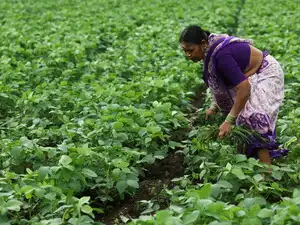
Called Smart Scout, the project will use computer vision and AI to help farmers identify soybean plants at risk of bending or falling over before harvest, measure the extent of crop damage and make more informed harvesting decisions. The aim is to detect problems early enough for farmers to respond and minimise losses.
The project is among six selected for the inaugural cohort of the Quad's Advancing Innovations for Empowering NextGen Agriculture (AI-ENGAGE) initiative, which brings together researchers from India, the US, Japan and Australia to apply emerging technologies to agricultural challenges. The six projects are supported by a combined investment of more than $6 million, with each participating agency funding research in its own country.
Soybean is the starting point for Smart Scout, given its importance to India's edible oil economy and global food and feed supply chains. India had around 12.95 million hectares under soybean cultivation in 2024-25, with Madhya Pradesh and Maharashtra accounting for approximately 84.5% of the country's area under the crop.
Lodging, in which plants bend or fall before harvest, is a major risk during the late stages of soybean cultivation when pods are filling and plants are at their heaviest. Heavy rain, strong winds, waterlogged soil, dense sowing and stem damage from pests can increase the risk. Once plants flatten, farmers face potential yield losses, poorer grain quality, disease and pod rot, besides higher harvesting costs.
Smart Scout is being designed to replace much of the reliance on manual field inspection with camera-based monitoring. The system can be carried by hand or mounted on sprayers and other farm machinery, allowing farmers to capture crop images during routine field operations.
The technology will analyse plant height, crop density, early signs of lodging and pest pressure. It will also generate a lodging score, estimate the percentage of a field affected and map the location of damage, providing farmers and agronomists with a more consistent assessment of crop conditions.
Another key component is in-season yield estimation. By counting soybean pods and measuring their length, the system aims to help farmers assess yield potential and prioritise fields for harvesting, while planning labour, machinery and sales.
Dr Ajay Sharda of Kansas State University in the US is leading the project internationally as Lead Principal Investigator. At IIT Kharagpur, Prof Peeyush Soni of the Department of Agricultural and Food Engineering is the Indian Principal Investigator, while Dr Shivam Sharma of Absolute is the Co-Principal Investigator. The consortium also includes researchers from Kobe University in Japan and the University of Southern Queensland in Australia.
IIT Kharagpur will lead work on data standardisation, image annotation and augmentation, yield-estimation models, pest-detection models and app development. Absolute will develop the AI-enabled computer-vision system for real-time monitoring, lodging assessment, in-season yield estimation and the data-visualisation dashboard. It will also evaluate the technology's usability and accuracy under field conditions.
The project builds on Absolute's existing AI capabilities through its Nature Intelligence Platform and Nature+ platform, which use machine learning to discover and design biological solutions. Its agri-biotech arm, INERA, will contribute field-validation capabilities, drawing on a network spanning more than 10 agro-climatic zones and over 50,000 field trials and farmer demonstrations.
Smart Scout's India programme began in 2026 and will run for three years. Pilot trials will cover more than 30 acres of soybean across Madhya Pradesh, Maharashtra and Karnataka, including around five acres at INERA's trial station in Pune. The project will subsequently focus on farmer training, stakeholder workshops and knowledge-sharing with Quad partners.
“Smart Scout will help farmers see lodging risk, crop damage and yield potential early enough to act,” said Soni. He said the collaboration aims to deliver field-ready AI suited to Indian conditions and capable of scaling across millions of hectares of soybean cultivation.
Sharma said a late-monsoon storm during pod filling could flatten soybean crops and cost farmers up to a third of their yield. “Smart Scout is built to read that risk while it is still forming,” he said.
With soybean a key focus of the government's National Mission on Edible Oils – Oilseeds, the project aims to help farmers protect the crop they have already grown by improving the timeliness and precision of field-level decisions. While soybean is the initial focus, the technology is being designed for potential adaptation to other crops.