
India-New Zealand FTA kicks in October 20, gives all Indian goods zero-duty access
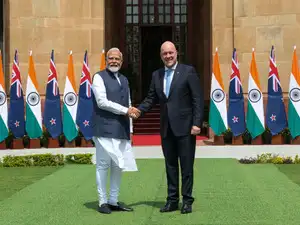 ANI
India-New Zealand FTA takes effect October 20, opens duty-free access for Indian exports.
The agreement will also open India's 1.4-billion-strong consumer market to New Zealand goods, expand opportunities in services and agriculture, and facilitate $20 billion in foreign direct investment from New Zealand into India over the next 15 years.
Announcing the implementation of the pact, Commerce and Industry Minister Piyush Goyal said it aims to increase bilateral trade in goods and services from around $2.4 billion to about 7 billion New Zealand dollars, or nearly ₹35,000 crore, by 2030.
Goyal was speaking at the flag-off of a small excavator manufactured by construction equipment maker JCB India for export to New Zealand under the trade agreement. He said the company currently exports 25% of its total production to various countries from India.
"I am giving them a target to increase it to 50 per cent. New Zealand is now the 140th export destination for them," he said.
Gains for India
New Zealand will provide 100% duty-free market access to Indian exports from October 20, covering all tariff lines and the entirety of India's current exports to the country. This marks the first time India has secured full duty-free access across all tariff lines from the start of an FTA.The elimination of import duties will remove the tariff disadvantage faced by Indian exporters, who previously faced duties of up to 10% in the New Zealand market.
Sectors expected to benefit include fruits and vegetables, coffee, tea, cocoa and spices, cereals, processed foods, textiles and clothing, leather and footwear, pharmaceuticals, engineering goods, marine products, plastics and rubber.
Sensitive sectors kept out of the pact
India has excluded several product categories from tariff concessions to protect domestic interests. These include dairy products such as milk, cream, whey, yoghurt and cheese, as well as animal products other than sheep meat.The exclusion list also covers vegetable products, including onions, chana, peas, corn and almonds; sugar and artificial honey; and animal, vegetable or microbial fats and oils.
Arms and ammunition, gems and jewellery, precious metals and finished jewellery products are also excluded. Copper and copper articles, including cathodes, cartridges, rods, bars and coils, along with aluminium and aluminium articles such as ingots, billets, wire, rods and bars, are among the protected categories.
Services, professionals to get greater access
Under the agreement, New Zealand has agreed to open 118 services sectors and sub-sectors to Indian service providers. These include information technology, professional services, telecommunications, construction, education, financial services and tourism.The provisions are expected to make it easier for Indian companies and professionals to offer services in New Zealand. The agreement also allows certain Indian professionals and business visitors to work or stay in the country for specified periods.
Employees transferred within the same company can stay for up to three years. Business visitors and workers installing or servicing equipment can stay for up to 90 days in a 12-month period, while contractual service providers and independent professionals can stay for up to 12 months.
The pact also creates a temporary employment entry visa pathway for skilled Indian workers, with a quota of 5,000 visas at any given time for stays of up to three years.
The pathway covers fields such as IT, engineering, construction, education and healthcare, as well as occupations including yoga instructors, chefs, music teachers and Ayush practitioners.
In agriculture, the agreement establishes a productivity partnership to strengthen cooperation between the two countries. Dedicated action plans for kiwifruit, apples and honey will focus on improving productivity and quality in India.
What New Zealand gains
India will offer tariff concessions on 70% of its tariff lines, covering around 95% of the current value of bilateral trade. The remaining 29.97% of tariff lines have been placed on the exclusion list.For New Zealand products such as apples, kiwifruit, Manuka honey and albumins, India will provide duty concessions through quotas, alongside minimum import price (MIP) provisions and other safeguards.
The framework is intended to allow calibrated imports while protecting domestic farmers.
New Zealand Trade and Investment Minister Todd McClay said the agreement would create opportunities for exporters across key sectors.
"Once fully implemented, 95 per cent of New Zealand's current exports to India will benefit from tariff elimination or substantial tariff reductions, creating new opportunities across many of our key export sectors," he said.
Commerce Secretary Rajesh Agrawal said the focus would now be on converting the agreement's provisions into concrete benefits.
"The job is now to see how we are able to take this FTA and translate this opportunity into actual benefits for our people," he said.
Faster customs clearance
The agreement provides for customs clearance within 48 hours for cargo and 24 hours for express and perishable consignments.Digital certification and self-certification of rules of origin for eligible status holders are also intended to reduce procedural delays and compliance costs.
Bilateral trade slips in FY26
Bilateral trade between India and New Zealand declined by around 11% to $1.15 billion in 2025-26, from $1.3 billion in the previous fiscal year.India's exports stood at $566.51 million, while imports were $589.1 million, leaving the country with a trade deficit of $22.59 million.