
Trump set for midterm test: What's in store for India, Iran, Ukraine after November 4?
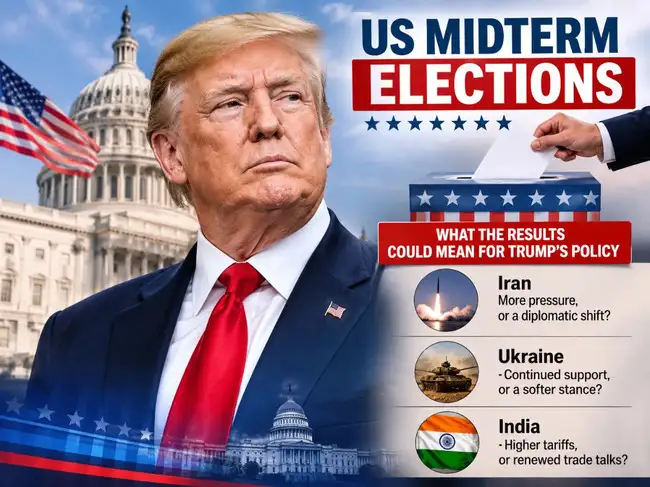
While the ballot will decide who controls the US Congress, the consequences will travel far beyond Washington -- from the battlefields of Iran and Ukraine to India's export markets and its long-running trade negotiations with Trump admin.
From India's perspective, the stakes on the result day will extend beyond Washington's domestic political balance. The outcome could influence US's approach to tariffs, trade negotiations, Russian oil purchases and the broader strategic relationship with New Delhi.
Also read | US pushes to restore Russian gas sales to Europe via Ukraine, WSJ reports
A change in congressional control, however, will not automatically translate into a change in US policy. The main question after November 4 will be whether a potentially stronger Democratic side can meaningfully influence Trump's decisions or merely make his remaining years in office more politically difficult.
US midterms: Democrat win could put Trump on defensive
As per the latest electoral math, Democrats have a credible opportunity to reclaim the House of Representatives, while the Senate contest remains considerably tighter.Republicans currently hold a 218-214 advantage in the House and a 53-47 majority in the Senate, meaning Democrats need a net gain of four seats in each chamber to overturn Republican majority.
A victory in the House alone would give Democrats control of committees, investigative powers and the ability to summon Trump admin officials for congressional hearings. Winning both chambers would provide them with considerably greater influence over legislation, government spending and presidential appointments.
Trump will remain in the White House regardless of which party controls Congress, retaining considerable authority over diplomacy, military operations, immigration and trade matters. He can veto legislation passed by lawmakers, while the Senate's filibuster rules make it difficult to pass most major bills without a 60-vote majority.
Therefore, even a Democratic sweep on November 4 will not automatically mean an end to Trump's policies. Its real effect would be to increase the political, legislative and institutional costs for Trump in enforcing them.
For Trump, the midterms also has another major angle beyond the congressional math. Foreign policy, traditionally a less decisive consideration in midterm voting, has this time become intertwined with mainstream rhetoric. The Iran war has driven energy costs significantly up in the US. And this has come on top of the already high pressure on American consumers and businesses on account of Trump's tariffs.
Also read | Trump’s test: A mixed report card before Midterms
According to a recent Reuters/Ipsos survey, 78% of Americans believed Trump's policies were responsible, at least partly, for rising prices that were outpacing their earnings.
Therefore, if Trump & Co faces a setback at the midterms, many analysts might interprete that as a rejection of both his track record on economy and his increasingly interventionist foreign policy.
How will US midterm election results impact India?
For India, the consequences are likely to be felt most directly through trade and tariffs.India has been navigating an increasingly difficult economic relationship with Washington, with negotiations for a bilateral trade agreement repeatedly encountering various barriers.
The February 2026 framework had brought down the punitive American tariff on most Indian goods from 50% to 18%. However, the subsequent uncertainty surrounding American tariff powers and a separate sanctions-related measure has complicated the path to a final agreement.
One of the main sticking points has been India's purchase of Russian crude oil, which Trump admin took big issue with until the time US itself cleared Russia's diesel exports. At one point, US even threatened India with a 100% tariff.
The US Supreme Court's invalidation of Trump's use of emergency powers for sweeping global tariffs later resulted in a 10% baseline rate.
An unfinished Section 301 investigation into alleged excess industrial capacity among several trading partners has added another layer of uncertainty over the eventual tariff treatment of Indian exports.
A Democratic win could increase congressional scrutiny of Trump's tariff strategy, particularly if lawmakers believe the duties are raising costs for American consumers and businesses. Democrats could organise hearings, challenge the administration's trade measures and introduce legislation seeking to roll back selected tariffs.
A Democratic-controlled Congress could also make trade policy a prominent issue in the run-up to the 2028 presidential election.
However, this does not mean Indian exporters should expect an immediate reduction in duties. Trump retains substantial executive authority to pursue tariffs through other legal mechanisms, and a presidential veto could block legislative attempts to reverse his policies.
As per latest reports (Reuters, Nov 1), even a Democratic takeover of Congress is unlikely to deter Trump from pursuing his tariff-driven economic agenda. Trump admin says it remains committed to using import duties to protect American workers, farmers and manufacturers.
Trade experts also expect congressional opposition to translate initially into oversight hearings and symbolic legislative attempts rather than big changes to existing tariff arrangements.
For countries such as India (as well as Vietnam and Canada), waiting for the US midterms for a major shift in Trump admin's position is likely to prove counterproductive, The Economic Times reported ahead of the polls.
The economic stakes for India are considerable. The US remains India's largest export market, with Indian goods exports to the country rising to $42.79 billion in April-August 2026, compared with $40.39 billion in the corresponding period a year earlier. India had a trade surplus of nearly $34 billion with the US in FY26.
Pharmaceuticals and smartphones, among India's significant export categories, are not covered by the existing 10% baseline levy. Be that as it may, further tariff increases, if any, could hurt Indian exporters, weaken business confidence and add pressure on the rupee.
A change in congressional control may also affect India-US bilateral dynamics in other ways. Democrats may demand greater scrutiny of Trump admin's Russia policy, including its sanctions and energy-related decisions. This could indirectly complicate India's efforts to balance its longstanding defence and energy ties with Moscow with its expanding strategic partnership with the US.
Some of the bilateral hiccups are likely to remain as they are. For example, US's grumbles over market access, industrial competition and India's trade surplus are not party-specific, and will likely continue regardless of whichever side does better at the midterms.
For India, the most important takeaway is that the midterm elections are unlikely to provide an immediate escape from tariff uncertainty. Even if Democrats gain control of Congress, the White House will continue to shape the country's trade and foreign policy for the remainder of Trump's term.
New Delhi will need to engage not only with the administration but also with lawmakers who influence sanctions, trade legislation, defence cooperation and America's wider policy priorities.
Iran war: What may be in store after November 4
One of the most pressing questions after the election pertains to the Iran war. Trump indicated he did not intend to launch another attack before November 3, but repeatedly left open the possibility of renewed military action afterwards.The war, which began on February 28, has entered its eighth month, and there is still no sign of the geopolitical uncertainty and oil market chaos abating anytime soon. If an attack is launched again, what happens to already volatile oil markets is anyone's guess.
There have been indications that have deepened the unease. AP recently reported that US officials had privately advised several Middle Eastern countries and regional allies to prepare for possible American strikes after the election, as well as potential Iranian retaliation against energy infra and other critical sites.
The war has already cost American taxpayers an estimated $47.1 billion, making its financial and political fallout hard to ignore for Trump.
A Democratic victory in either chamber could make it harder for Trump to sustain his war without congressional scrutiny. More empowered Democrats won't necessarily stop Trump from ordering strikes, but they could increase the political cost of escalation.
If the Democrats do well, Trump might face more pressure to show progress in talks rather than commit the US to another face-off. On the other hand, if Republicans win this round, Trump might feel emboldened to argue that voters have backed his approach.
US midterms: What awaits Ukraine?
Trump has largely stopped American assistance to Ukraine despite considerable bipartisan support in Congress for for helping the war-ravaged country. Trump admin's easing of certain sanctions on Russian energy exports has also drawn flak. The Democrats, if they come to control Congress, could attempt to reverse some of this direction.Any immediate change in the war is unlikely, though. Trump's Russia strategy -- his willingness to engage Putin -- means he might continue with the same line on Ukraine war.
For Ukraine, the election could therefore determine how much institutional support becomes available in Washington rather than guarantee a decisive change in American strategy.
The final word
The two possible electoral outcomes give contrasting political signals.If Republicans retain control of both chambers, Trump could claim that voters have endorsed his policies and continue pursuing his foreign and economic agenda with relatively little congressional resistance.
A Democratic victory in the House, particularly if accompanied by gains in the Senate, would give the opposition greater leverage over investigations, appointments, spending and legislation. It could also make the administration more accountable for the consequences of its decisions on Iran, Ukraine and international trade.
There is yet another possibility: faced with a stronger domestic opposition, Trump might just become more assertive internationally rather than retreat.
US foreign policy offers presidents considerable scope for independent action, particularly when domestic legislative agenda becomes difficult to push through.
A president facing political constraints at home may seek to demonstrate strength abroad, Reuters reported just ahead of the polls. If there is a setback for Trump, whether he responds to it with greater diplomatic engagement, more wars or higher tariffs, is therefore an open question.
For India, even if the election changes the political balance in Washington, the challenge will remain more or less the same: try and have stable ties with a partner country whose domestic politics increasingly decides how it pursues trade and other critical matters.