
US midterm elections begin tomorrow: Can Trump’s likely defeat sparkle Sensex, Nifty? Here’s what analysts say
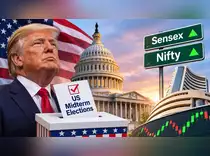 ETMarkets.com
Republicans currently control both chambers of Congress. However, a survey conducted ahead of the 2026 US midterm elections indicated that Trump was losing ground among several voter groups that helped return him to the White House in 2024. A Democratic victory in the midterms could result in a divided Congress.
A divided US government, with Democrats and Republicans sharing control of Congress, typically leads to heightened market volatility, although annualised stock market returns remain largely unaffected. Policy uncertainty, political power struggles and the resulting legislative gridlock can contribute to market swings.
Also read | US Elections 2026: Trump's midterm headache grows as polls show Democrats gaining ground in key races
Dalal Street, meanwhile, faces several headwinds of its own. Trump's tariff flip-flops, rising oil prices and bond yields, and persistent FII outflows have dragged the Sensex and Nifty down 12% so far in 2026. Against this backdrop, investors are closely tracking the US midterm elections for their potential implications for global markets.
What impact can US midterm elections have on the Indian stock market?
But markets do not fear elections; they fear uncertainty, and Dalal Street already has plenty of it, said Vaqarjaved Khan, Senior Fundamental Analyst at Angel One. With oil prices soaring, US yields elevated and FIIs selling for ten consecutive weeks, the midterms are one more headline rather than the main driver, according to the analyst.Tanvi Kanchan, Associate Director at Anand Rathi Shares & Stock Brokers, also said that the US midterm elections are unlikely to be the trigger that decides the direction of Indian markets. At most, they are a volatility event layered on top of much bigger pressures.
“Markets have largely priced in the outcome already. Prediction markets give the Democrats roughly a 90% chance of taking the House, and the Senate is the only real contest. A divided Congress is something markets have lived with many times. If anything, it reduces the scope for sweeping fiscal or tariff moves,” she added.
Explaining the potential impact on India, Kanchan said the elections matter through two key channels: the dollar and US interest rates. She noted that these have been the primary sources of pressure on Indian equities this year. FPIs have pulled out more than Rs 3 lakh crore so far in 2026, almost double their total withdrawals in 2025, while the Nifty has declined around 12% this year.
Also read | Diwali 2026: Sensex plunged 10,000 points, Nifty dropped 12% since last Diwali. Will Samvat 2083 bring some relief?
What investors can expect?
“If Congress splits, gridlock usually follows, which Wall Street tends to tolerate,” Khan from Angel One said. He advised investors to expect choppy, headline-driven sessions around November 3 and 4, with the Nifty respecting the 22,400-22,500 zone.“The real trigger will be crude and the Iran situation, not the ballot count. Investors should avoid reacting to short-term noise, stagger their entries and focus on earnings quality while domestic flows continue to absorb foreign selling,” he added.
Kanchan from Anand Rathi Shares & Stock Brokers, meanwhile, expects some short-term volatility around the results, especially if counting is delayed or a key Senate race is contested. However, she does not expect a structural break in either direction.
What drives the market beyond the midterm elections is the Fed's tone, the direction of crude prices and whether FPI selling exhausts itself, the analyst said. If a divided Congress and a softer US economy push the Fed towards a pause, pressure from US yields could ease, which would be the real positive for Indian equities, she added.
Also read | Elon Musk warns ‘game over’ if Democrats sweep 2028 elections