
Why India's steel demand is defying global weakness
 ET CONTRIBUTORS
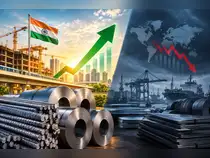
India’s steel market outperforms global peers as infrastructure and manufacturing boost demand, while Chinese oversupply and weak overseas consumption weigh on international prices.
India Bucks the Global Trend
India's steel market has emerged as one of the strongest among major economies this year, with domestic prices rising sharply even as overseas markets remain subdued. The contrast reflects a widening divergence between India's demand-driven growth story and the supply-heavy conditions prevailing globally. Strong infrastructure spending, manufacturing expansion, construction activity, and higher production costs have supported domestic steel prices, while global markets continue to struggle with excess supply and weak demand, particularly from China.A Demand-Led Rally
Unlike the post-pandemic rally of 2021-22, which was driven largely by global supply disruptions and commodity inflation, the current uptrend is being fueled primarily by domestic factors. Massive investments in highways, railways, metro projects, ports, airports, renewable energy facilities, defence infrastructure, and industrial corridors have significantly boosted steel consumption. Manufacturing activity has also strengthened under initiatives such as Make in India and production-linked incentive (PLI) schemes.Demand from automobiles, engineering goods, capital equipment, and housing has further supported consumption. On the cost side, steelmakers have faced higher expenses for coking coal, iron ore, power, freight, and logistics. Rising energy costs and disruptions in key shipping routes have also increased transportation expenses, providing additional support to steel prices.
Healthy Domestic Fundamentals
India remains one of the fastest-growing steel markets globally, supported by rapid urbanization, industrialization, and infrastructure development. Despite substantial capacity additions by domestic producers, demand growth has largely kept pace, preventing significant oversupply and maintaining healthy capacity utilization levels.As the world's second-largest crude steel producer, India has significantly expanded output over the past decade. Imports, however, continue to play a role, particularly for value-added and specialty grades used by the automotive and engineering sectors. While lower-priced imports from China, South Korea, and Japan pose a challenge, robust domestic consumption has largely absorbed these volumes, helping keep the market balanced.
Why Overseas Prices Remain Weak
The primary reason for weaker international steel prices is oversupply, led by China. The country's property sector, historically the biggest driver of global steel demand, continues to face a prolonged slowdown. Housing starts, construction activity, and real-estate investment remain below historical levels, reducing domestic steel consumption.However, Chinese steel production has not fallen at the same pace. Many mills continue operating due to employment concerns and regional economic priorities, resulting in large export volumes entering global markets. The availability of competitively priced Chinese steel has increased competition across Asia, Europe, Africa, and the Middle East, limiting any meaningful recovery in international prices.
Global Market Struggles with Excess Supply
Beyond China, major producing regions such as Japan, South Korea, Russia, Turkey, Europe, and the United States continue to contribute substantial supplies. Although the United States has benefited from infrastructure investment and industrial spending, demand remains below post-pandemic peaks. Europe, meanwhile, continues to face weak manufacturing activity and high energy costs.While emerging economies such as India, Southeast Asia, and parts of the Middle East have provided support through infrastructure development and industrial expansion, their growth has not been sufficient to fully offset weaker Chinese demand. As a result, global supply growth continues to outpace demand growth, keeping international steel prices under pressure.
Outlook: India Likely to Outperform
The outlook for Indian steel remains relatively constructive. Continued investments in infrastructure, transportation, renewable energy, defence, housing, and manufacturing are expected to support consumption in the coming years. Although ongoing capacity expansions could increase supply, demand growth is likely to remain strong enough to prevent a major oversupply situation. The key risk remains a surge in cheaper imports if the price gap between India and overseas markets widens further.Globally, the outlook remains more subdued. A meaningful recovery in international steel prices would likely require either a revival in Chinese demand or significant production cuts by major steel-producing nations. Until then, abundant supplies and weak consumption growth are expected to keep global prices relatively soft.
(The author Hareesh V is Head of Commodity Research, Geojit Investments Limited. Views are own)